Category: Physics and Learning

  • How to Build Strong Physics Concepts: A Step-by-Step Learning Guide

    Physics becomes much easier when students focus on understanding concepts rather than trying to memorize formulas without knowing where or why they are used. A strong conceptual foundation helps students solve numerical problems, understand diagrams, remember formulas and apply Physics to unfamiliar situations.

    1. Start with the Basic Idea

    Before learning a formula, first understand the basic physics concepts involved. Ask simple questions: What does it represent? What is its SI unit? What factors affect it? How is it related to other physical quantities?

    For example, while studying velocity, a student should understand its meaning, direction and relation with displacement and time before immediately using equations of motion.

    2. Understand the Physical Situation

    Physics describes real physical situations through mathematical relationships. Try to imagine what is happening in the problem.

    Draw a simple diagram whenever possible. A diagram can show directions, forces, distances, angles, electric fields, magnetic fields or motion much more clearly than words alone.

    3. Learn the Formula with Meaning

    Do not treat a formula as a collection of symbols. Understand what every symbol represents and check its unit.

    For example, the magnetic force between two long parallel wire carrying currents is given by the formula:
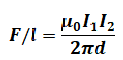
    Magnetic force per unit length between two parallel current-carrying wires

    The terms used in the formula have specific physical meanings. Understanding these meanings makes the equation easier to remember and apply correctly.

    4. Connect Related Concepts

    Physics topics are interconnected. Connecting related physics concepts helps you understand how different topics are linked with one another. Motion is connected with force, force with work and energy, electricity with circuits, and magnetism with moving charges.

    When you study a new chapter, try to connect it with concepts you have already learned. These connections gradually create a strong conceptual framework.

    5. Practice Different Types of Problems

    After understanding a concept, solve problems of different levels. Begin with basic questions and gradually move towards application-based and numerical problems.

    Do not look at the solution immediately when you face difficulty. First identify what is given, what is required and which physical principle may be useful.

    6. Revise through Short Notes

    Make concise revision notes containing important formulas, definitions, units, graphs and common mistakes. Regular short revision is generally more useful than trying to learn everything immediately before an examination.

    7. Learn From Mistakes

    Mistakes are an important part of learning Physics. Maintain a small “mistake notebook” and record errors such as incorrect units, wrong signs, incorrect formula selection or calculation mistakes.

    Over time, this can help you identify repeated weaknesses.

    Conclusion

    Strong Physics concepts develop gradually through understanding, visualization, mathematical reasoning and regular practice. Instead of asking only “Which formula should I use?”, try asking “What physical principle is working here?”

    Once the concept becomes clear, formulas become easier to understand, remember and apply.

    A strong understanding of physics concepts helps students approach unfamiliar problems with greater confidence.

    Physics is not only about remembering equations—it is about understanding how nature works.


    Internal Link

    Conceptual Learning in Physics

  • Why Physics is the Language of Nature

    Understanding the Universe Through the Eyes of Physics

    By Er. Birendra Pratap Singh
    Physics & Engineering Educator


    Introduction

    Have you ever wondered why an apple falls towards the Earth instead of moving upward? Why does a rainbow appear after rain? How does a satellite remain in orbit? Why do mobile phones communicate instantly across continents?

    The answers to all these questions lie in one fascinating subject—Physics.

    Physics is often called “The Language of Nature” because it explains the fundamental laws that govern the universe. Just as language helps us communicate with people, Physics helps us understand the natural world.


    What Does “The Language of Nature” Mean?

    Nature constantly communicates with us.

    The movement of planets…

    The sound of thunder…

    The shining of stars…

    The flow of electricity…

    The flight of birds…

    All these are expressions of natural laws.

    Physics provides the vocabulary and grammar needed to understand these phenomena.


    Every Natural Phenomenon Follows Laws

    Nature does not work randomly.

    Every event follows scientific principles.

    For example:

    • Objects fall due to gravity.
    • Light travels at a finite speed.
    • Electric current flows because of potential difference.
    • Sound requires a material medium.
    • Energy is always conserved.

    These universal laws make Physics the language through which Nature speaks.


    Mathematics: The Alphabet of Physics

    Mathematics and Physics are inseparable.

    It provides symbols, equations, and calculations.

    Physics gives them physical meaning.

    For example:

    F = ma

    This simple equation is more than a formula.

    It describes how force changes the motion of an object and forms the foundation of mechanics.

    Thus, mathematics becomes the alphabet, while Physics becomes the language.


    Physics is Everywhere

    Many students believe Physics exists only inside textbooks.

    In reality, Physics surrounds us every moment.

    Examples include:

    • Mobile phones
    • Ceiling fans
    • Refrigerators
    • Air conditioners
    • Electric vehicles
    • GPS navigation
    • Medical imaging
    • Solar panels

    Every modern technology is built upon the principles of Physics.


    Understanding Instead of Memorizing

    One of the biggest misconceptions among students is that Physics is only about formulae.

    In reality,

    Physics is about understanding relationships.

    When you understand:

    • Why things happen,
    • How they happen,
    • Under what conditions they happen,

    formulae become easy to remember.


    Nature is the Greatest Physics Laboratory

    A student does not always need sophisticated equipment to observe Physics.

    Simply look around.

    Observe:

    • Falling rain
    • Flowing rivers
    • Flying birds
    • Moving clouds
    • Shadows
    • Rainbows
    • Mirrors
    • Magnets

    Everyday life offers countless opportunities to learn Physics.


    Physics Builds Logical Thinking

    Physics trains the mind to think scientifically.

    Students learn to:

    • Observe carefully.
    • Analyse logically.
    • Solve problems systematically.
    • Question assumptions.
    • Draw conclusions based on evidence.

    These skills remain valuable throughout life.


    Physics Connects Different Sciences

    Physics forms the foundation of many disciplines.

    Chemistry depends on Atomic Physics.

    Biology uses Biophysics.

    Engineering applies Mechanics and Electricity.

    Medicine relies on X-rays, MRI, Ultrasound, and Radiation Physics.

    Astronomy depends upon Optics and Gravitation.

    Thus, Physics connects almost every branch of science.


    Great Scientists Saw Nature Differently

    Scientists like:

    • Isaac Newton
    • Albert Einstein
    • James Clerk Maxwell
    • Michael Faraday
    • Marie Curie
    • C. V. Raman

    did not merely observe Nature.

    They asked questions that others ignored.

    Their curiosity transformed human civilization.


    Why Every Student Should Learn Physics

    Studying Physics develops:

    • Curiosity
    • Critical thinking
    • Creativity
    • Observation
    • Problem-solving
    • Scientific attitude

    Even students who do not pursue engineering or medicine benefit immensely from learning Physics.


    Physics and Everyday Decision Making

    Physics helps us make better decisions in daily life.

    Examples include:

    • Driving safely
    • Using electricity wisely
    • Conserving energy
    • Understanding weather
    • Choosing efficient appliances
    • Appreciating modern technology

    Knowledge of Physics improves both awareness and responsibility.


    The Beauty of Physics

    The beauty of Physics lies in its simplicity.

    A single equation can explain the motion of planets.

    A simple law can describe the behaviour of light.

    A tiny electron can power an entire civilization.

    The more we study Physics, the more we appreciate the elegance of Nature.


    Key Takeaways

    • Physics explains the laws governing Nature.
    • Mathematics provides the language through which Physics is expressed.
    • Every natural phenomenon follows scientific principles.
    • Physics is present in everyday life.
    • Conceptual understanding is more valuable than memorization.
    • Physics develops logical and analytical thinking.

    Frequently Asked Questions (FAQ)

    Why is Physics called the language of Nature?

    Because it explains the universal laws that govern all natural phenomena, from the smallest particles to the largest galaxies.

    Is Physics only useful for engineers and doctors?

    No. Physics develops scientific thinking and problem-solving skills that are useful in every profession.

    Is Physics difficult?

    Physics becomes difficult only when students memorize instead of understanding concepts.

    How can I start enjoying Physics?

    Observe Nature, ask questions, perform simple experiments, and connect classroom concepts with daily life.


    Conclusion

    Nature has been speaking to humanity since the beginning of time.

    The rising Sun, the flowing river, the falling apple, the shining stars, and the silent movement of galaxies all communicate through universal laws.

    Physics teaches us how to understand this beautiful language.

    The more we learn Physics, the more clearly we hear the voice of Nature.


    Quote of the Day

    “Physics is not merely a collection of equations; it is the language through which Nature reveals its deepest secrets.”

    — Er. Birendra Pratap Singh


    About the Author

    Er. Birendra Pratap Singh
    Physics & Engineering Educator

    Dedicated to making Physics simple, conceptual, and inspiring for every learner.

    Visit: https://birendrapsingh.com

    Internal Link

    Importance of Conceptual Learning

    Internal Link

    Why Physics is More Than Just Formula

  • Why Physics is More Than Just Formulae

    By Er. Birendra Pratap Singh

    Physics is often considered one of the most challenging subjects by students. Many learners believe that Physics is merely a collection of formulas and numerical problems. However, the true essence of Physics lies in understanding the laws of nature and applying them to real-life situations.

    It explains how objects move, why the sky appears blue, how electricity powers our homes, and how communication systems connect people across the world. It helps us understand the natural world through observation, experimentation, and logical reasoning.

    One common mistake made by students is focusing solely on memorizing formulae. Formulae are important tools. they are meaningful only when the underlying concepts are understood. For example, Newton’s laws of motion are not just equations; they explain how forces influence the movement of objects in everyday life.

    Conceptual understanding is particularly important in Physics. Students should ask questions such as:

    – Why does this phenomenon occur?
    – What assumptions are involved?
    – How can this principle be applied in practical situations?

    Regular problem-solving is another essential aspect of learning Physics. Numerical questions help students apply theoretical concepts and strengthen analytical thinking skills. However, solving problems without understanding concepts often leads to confusion.

    Physics also plays a vital role in technological advancement. Modern inventions such as computers, smartphones, satellites, medical imaging devices, and renewable energy systems are based on principles of Physics.

    To study Physics effectively, students should:

    1. Focus on concepts before formulas.
    2. Draw diagrams whenever possible.
    3. Relate theories to real-life examples.
    4. Practice numerical problems regularly.
    5. Revise important concepts periodically.

    Conclusion: Physics is not merely a subject for examinations. It is a way of understanding the universe and developing scientific thinking. Students who learn Physics conceptually develop problem-solving abilities that benefit them throughout their academic and professional lives.

    (Er. Birendra Pratap Singh)

    Internal Link

    Importance of Conceptual Learning

  • Importance of Conceptual Learning

    Why rote memorization is dead and why conceptual learning is your new super power?

    Suppose, it is the night before your major exam or a big work presentation. You were staring at a wall of text, frantically cramming definitions, formulae, or bullet points into your brain, praying to God they stick for at least the next 12 hours.

    You passed the test. But few days later, the information is entirely gone. This is the trap of rote memorization. It treats your brain like a temporary storage locker. If you would like to actually succeed, in fast-pased, unpredictable world, you need to upgrade to conceptual learning.

    Rote learning is like memorizing where one specific piece goes without looking at the box. If the board shifts, you were lost.

    What is conceptual learning?

    Conceptual learning is understanding the whole picture. It is focusing on the Why and the How, rather than just the What.

    Instead of memorizing the fact that E = mc2 , conceptual learning means understanding how energy and mass are two sides of the same coin. Once you understand the core concept, you do not need to memorize the facts- you know them.

    Importance of Conceptual learning inpPhysics

    Why conceptual learning is a game- changer?

    If you are still on the fence about ditching the flashcards, here is why shifting to a conceptual mindset is worth the effort:

    1. Permanent shelf life: When you memorize a fact, it stays in your short term memory and decays quickly. When you understand a concept, it wires itself into your long-term neural pathways. You might forget a specific date from a history lesson, but you never forget why the economic pressures led to that war.
    2. Role of plug and play: This is transferrable skills. Rote learners struggle when the rules change. Conceptual learners excel because they can take a core principle learned in one domain and seamlessly apply it to a brand new problem. Suppose, you taught a student that current density is the current passes though a conductor per unit its cross-sectional surface area. So, its SI unit is A/m2 . Now, at the same time, it is said that current density is equal to conductivity of a conductor multiply by electric field intensity. So find its SI unit that will be same as A/m2 , the student should find it how it comes.

    How to start thinking conceptually today?

    Use these three simple mental habits:

    The Toddler Strategy:

    Channel your inner four-year-old, when learning something new, ask, why? at least three times deep. Do not stop at the surface level.

    The Feyman Technique:

    Try to explain the concept to a 10-year-old using simple language and zero jargon. If you stumble, you do not fully understand the concept yet.

    Look for Analogies:

    Concept new ideas to things you already know. For example, an electrical circuit is basically like water flowing through pipe.

    Remember above three mental habits.

    The bottom line:

    Memorization gets you through the day; conceptual learning gets you through life.

    Thanking you for reading,

    -Er. Birendra Pratap Singh

    Internal Link

    Why Physics Is more than Just formulae