Physics becomes much easier when students focus on understanding concepts rather than trying to memorize formulas without knowing where or why they are used. A strong conceptual foundation helps students solve numerical problems, understand diagrams, remember formulas and apply Physics to unfamiliar situations.
1. Start with the Basic Idea
Before learning a formula, first understand the basic physics concepts involved. Ask simple questions: What does it represent? What is its SI unit? What factors affect it? How is it related to other physical quantities?
For example, while studying velocity, a student should understand its meaning, direction and relation with displacement and time before immediately using equations of motion.
2. Understand the Physical Situation
Physics describes real physical situations through mathematical relationships. Try to imagine what is happening in the problem.
Draw a simple diagram whenever possible. A diagram can show directions, forces, distances, angles, electric fields, magnetic fields or motion much more clearly than words alone.
3. Learn the Formula with Meaning
Do not treat a formula as a collection of symbols. Understand what every symbol represents and check its unit.
For example, the magnetic force between two long parallel wire carrying currents is given by the formula:
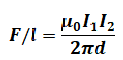
The terms used in the formula have specific physical meanings. Understanding these meanings makes the equation easier to remember and apply correctly.
4. Connect Related Concepts
Physics topics are interconnected. Connecting related physics concepts helps you understand how different topics are linked with one another. Motion is connected with force, force with work and energy, electricity with circuits, and magnetism with moving charges.
When you study a new chapter, try to connect it with concepts you have already learned. These connections gradually create a strong conceptual framework.
5. Practice Different Types of Problems
After understanding a concept, solve problems of different levels. Begin with basic questions and gradually move towards application-based and numerical problems.
Do not look at the solution immediately when you face difficulty. First identify what is given, what is required and which physical principle may be useful.
6. Revise through Short Notes
Make concise revision notes containing important formulas, definitions, units, graphs and common mistakes. Regular short revision is generally more useful than trying to learn everything immediately before an examination.
7. Learn From Mistakes
Mistakes are an important part of learning Physics. Maintain a small “mistake notebook” and record errors such as incorrect units, wrong signs, incorrect formula selection or calculation mistakes.
Over time, this can help you identify repeated weaknesses.
Conclusion
Strong Physics concepts develop gradually through understanding, visualization, mathematical reasoning and regular practice. Instead of asking only “Which formula should I use?”, try asking “What physical principle is working here?”
Once the concept becomes clear, formulas become easier to understand, remember and apply.
A strong understanding of physics concepts helps students approach unfamiliar problems with greater confidence.
Physics is not only about remembering equations—it is about understanding how nature works.
Internal Link
Leave a Reply